Website policy
Media Usage Policy
How journalists, reviewers, producers, event organizers, and partners may use approved Five C Theory materials.
Last updated August 6, 2026
Purpose and scope
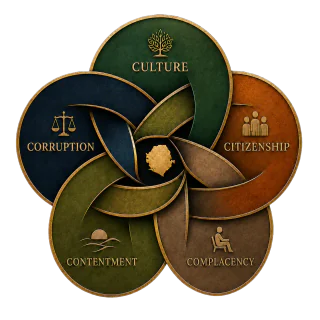
This policy applies to book-cover images, author photographs, the official Five C emblem, press descriptions, biographies, quotations, audio, video, podcast material, event material, and other assets supplied through the Media Center or directly by Leone Connect Publishing.
Approved editorial use
News organizations, reviewers, and journalists may use an asset clearly marked for media use to report on, review, or discuss The Five C Theory, Bhai-Dhawa Sesay, or an authorized event. Use only the current approved file and the factual caption or description supplied with it.
This editorial permission does not include advertising, paid promotion, merchandise, product packaging, fundraising, political campaigning, endorsement, sponsorship, adaptation, stock-library distribution, or use unrelated to the coverage.
Alteration limits
Do not redraw, recolor, distort, animate, reconstruct, remove elements from, or add text or branding over the official emblem, book cover, or another protected graphic. Do not use generative or manipulative tools to change a person’s appearance, fabricate a scene, alter a quotation, or create an unofficial derivative that could be mistaken for approved material.
Reasonable technical resizing or cropping of an approved photograph is allowed when it preserves context, dignity, legibility, and the supplied credit. The complete book cover and emblem should remain intact. Ask before making any other edit.
Credit and attribution
Keep embedded rights information and use the credit supplied with the asset. When no specific credit is provided, use: “The Five C Theory / Leone Connect Publishing.” Identify Bhai-Dhawa Sesay accurately as the author. Do not imply that the author, publisher, or project endorses the publication, organization, product, candidate, party, or cause.
Quotations and context
Short quotations may be used for reporting, review, criticism, commentary, or scholarship where permitted by law, with accurate attribution and enough context to avoid changing the meaning. There is no automatic safe word count. Substantial excerpts, complete chapters, transcripts, repeated extracts, or uses that substitute for the original work require written permission.
Private manuscript feedback, unpublished correspondence, recorded planning discussions, or interview preparation may not be published as a review, testimonial, quotation, affiliation, or endorsement without separate written approval.
Audio, video, podcast, and event material
Do not rebroadcast, repost, clip, transcribe, synchronize, remix, caption inaccurately, or commercially exploit audio or video unless the supplied license or written permission allows it. A link or embedded player offered by the website may be shared in the manner provided. Recording an appearance, interview, workshop, or event requires advance agreement about the platform, audience, duration, editing, credits, archive, and later reuse.
Advertising, sponsorship, and commercial use
Written permission is required for advertisements, sponsored content, merchandise, fundraising, promotional campaigns, paid courses, commercial training, packaging, product endorsements, or any use likely to imply a commercial relationship. Permission for one use does not authorize a different platform, territory, language, term, or campaign.
Embargoes, accuracy, and corrections
Honor any written embargo or release condition attached to advance material. Verify publication status, dates, prices, editions, and biographical facts against the current Media Center. If an error is identified, correct it promptly and, where appropriate, link to the public Corrections record.
Permission requests
If the intended use is not clearly allowed here, submit the exact asset, publication or production, purpose, format, territory, language, audience, estimated reach, term, release date, and whether access is free or paid through Rights and Permissions. A request or email acknowledgment is not permission; approval exists only in a separate written grant.
Questions and concerns
Use the Media Center for interviews, review copies, and approved assets. Use Contact and Support to report an inaccurate credit, unauthorized alteration, or other concern.