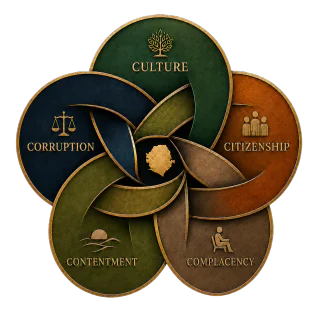
A new framework for Sierra Leonean public life
The 5C Theory
Culture, Corruption, CITIZENSHIP, Contentment, and Complacency in Sierra Leone
Why does replacing political leadership so often leave the relationships surrounding public power intact?
A Sierra Leonean inquiry into how social obligation, private access, political identity, adaptation, and public expectation interact—and how equal citizenship can interrupt public failure.
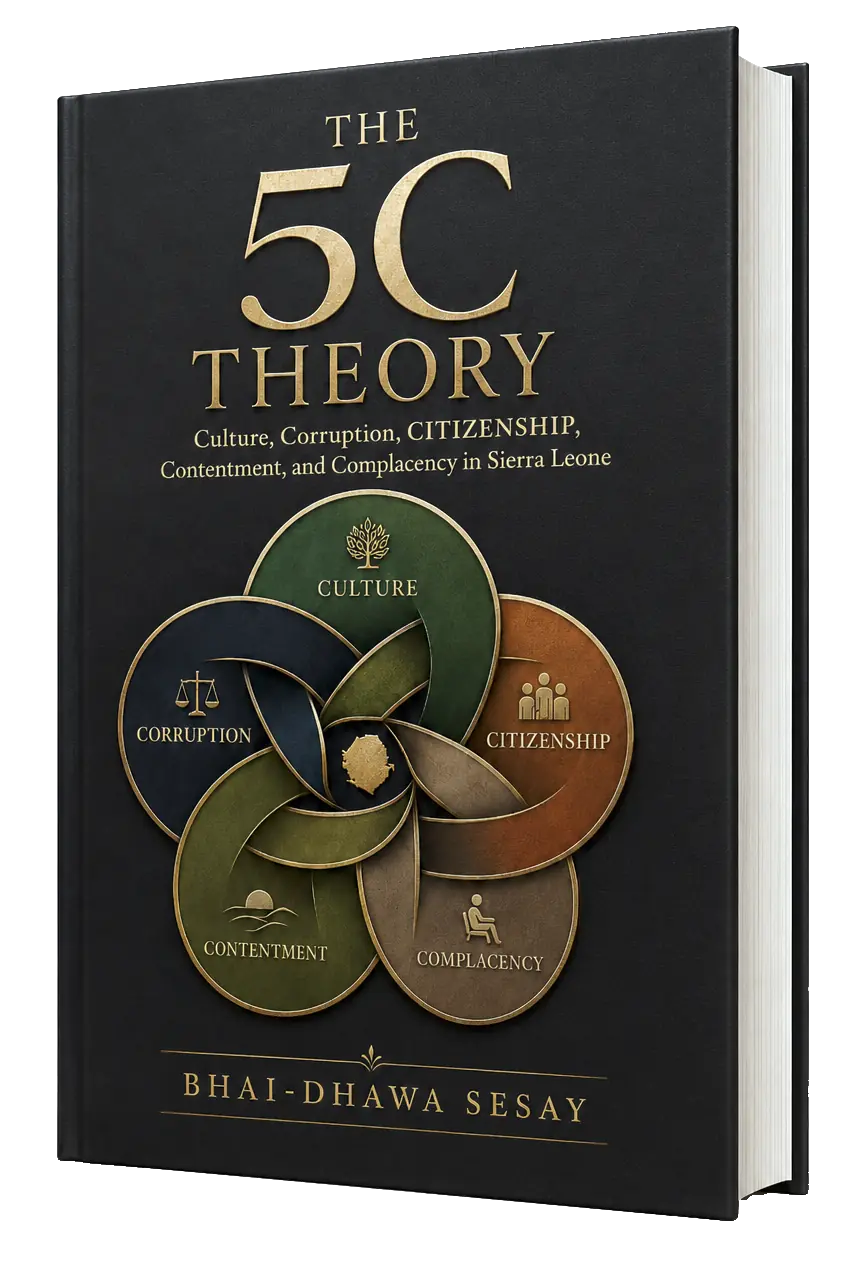 Publication in preparation
How the Five Cs interact
The Five C Theory examines relationships among people, institutions, incentives, and public standards. Cultural obligation can legitimise private access; corruption can weaken equal citizenship; coping can conceal unmet duties; and complacency can normalise an inadequate standard. These links are conditional. Culture, citizenship, and contentment also supply resources for resistance.
Explore the theoryFive domains · Connected public questions
The Five Cs
The Five Cs are domains of public life, not five equally harmful forces. Use them as questions to test against evidence, variation, and cases that do not fit.
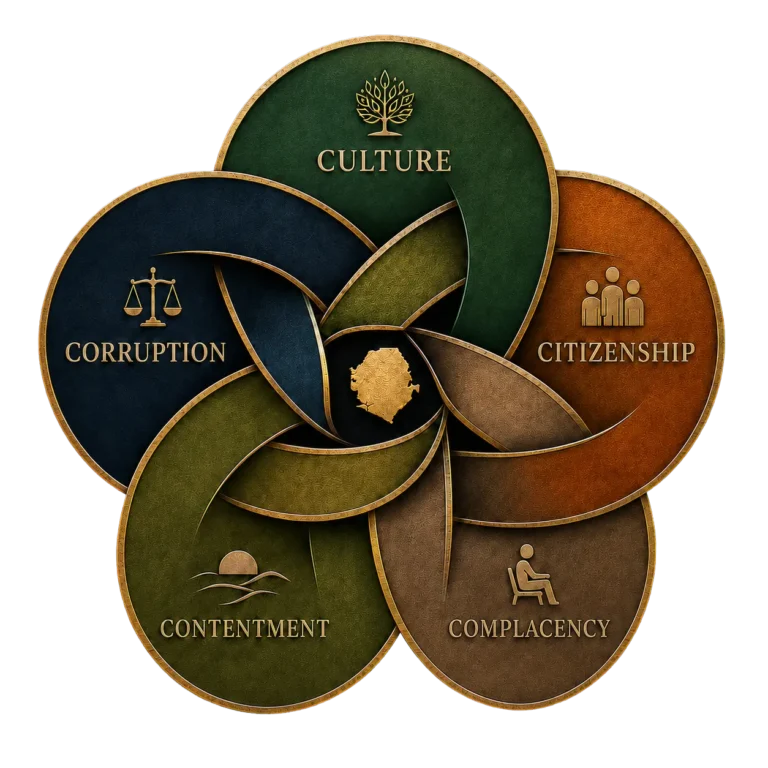
Text equivalent: Culture can widen solidarity; corruption distorts entrusted authority; citizenship protects equal public membership; contentment values personal sufficiency without settling public obligations; complacency normalises an inadequate public standard. The linked sections examine these relationships and how they can reinforce or interrupt public failure.
 CultureCorruptionCitizenshipContentmentComplacency
Select a section of the emblem
Culture
Belonging can widen public care.Belonging, respect, family obligation, and loyalty sustain community. They become harmful when private claims displace the fair treatment owed to unfamiliar citizens.
Explore CultureCorruption
Entrusted authority is distorted.Corruption extends beyond cash to manipulated opportunities, conflicts of interest, selective enforcement, and protection of allies. Responsibility grows with power and realistic alternatives.
Explore CorruptionCitizenship
Equal membership without a patron.Citizenship asks whether a decision is fair, explained, and available under the same standard to allies and opponents. A person can move among citizen, supporter, client, and subject postures.
Explore CitizenshipContentment
Private enough; public not yet.Contentment values life without endless accumulation. It differs from resilience and adaptation. A modest, meaningful life remains compatible with demanding safe schools, reliable services, and accountable government.
Explore ContentmentComplacency
An inadequate standard becomes normal.Complacency normalises an inadequate public standard. Fear, exhaustion, strategic withdrawal, and doubt about a particular campaign do not establish complacency by themselves.
Explore ComplacencyThe book
A diagnosis of the country we manage—and a map toward the republic we must refuse to abandon.
The Five C Theory develops its argument across 24 chapters: five parts examine the Cs, followed by four chapters on citizenship reclaimed, institutional accountability, organised public action, and Sierra Leone’s future.
- Examine how the Five Cs reinforce or interrupt public failure
- Examine citizenship beyond elections
- Turn private frustration into public questions
- Follow a public claim from evidence and responsibility to remedy and verified closure
“The connected citizen owes the unknown citizen a system that does not require connection.
— Bhai-Dhawa Sesay, The Five C Theory, Chapter Twenty-Four
Who the book is for
A public conversation with many entry points.
For younger readers
Explore Five C stories and games.
Find the children’s books and games companion, suggested for ages 7 and up.
Explore Stories & GamesSpeaking
Bring the Five C conversation to your audience.
Keynotes, lectures, moderated conversations, workshops, class visits, and media interviews.
Invite Bhai-Dhawa SesayInstitutions & groups
Put the book into a shared conversation.
For universities, organizations, reading groups, events, libraries, and civic programs.
Request a Bulk-Order QuoteLatest from The Five C Theory
Read, listen, and watch the framework in motion.
The homepage follows the newest publicly released work automatically. Drafts, unreleased episodes, and withheld videos remain private.
From Private Complaint to Public Action
Public frustration becomes politically meaningful when it acquires evidence, a specific demand, shared ownership, and follow-through.
Read the full InsightThe Unknown Citizen Test
The Theory Is Not a Sentence. It Is a Map.
When Loyalty Becomes Complicity
Meet around the ideas
Upcoming events
Book conversations, civic discussions, workshops, media appearances, and cultural programs.
No public dates have been announced. Receive event updates or plan an event.
The Five C Dispatch
Follow the book and the conversation.
Get publication updates and selected essays, with news of confirmed events and new reader resources.
Latest publishing
Latest from The Five C Blog
Author reflections, framework applications, book developments, and confirmed project updates.
Preparing The Five C Conversation Podcast
The format, accessibility standard, and editorial direction being prepared for The Five C Conversation podcast.
Read articleHow an Insight Moves from Draft to Verified Publication
A transparent look at the Five C editorial workflow from source material to a verified public Insight.
Read articleHow Educators and Book Clubs Can Use The Five C Theory
Practical, open-access ways for educators and book clubs to begin using the Five C framework before publication.
Read article