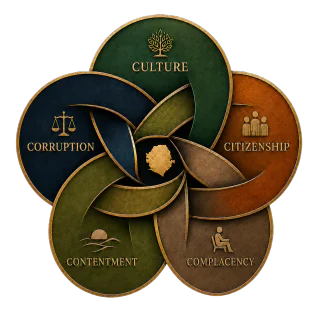
The Five Cs · 02
Corruption
The distortion of entrusted power for an improper advantage, including manipulated opportunity, selective access, and protected wrongdoing.
Part Two: Corruption
Who controls the choice, who benefits, and who bears the cost?
Corruption is often imagined as a secret payment: money is offered, a rule is ignored, and public duty is sold. That image is important but incomplete. Corruption becomes systemic when improper influence begins to shape how people expect public life to work. The citizen asks whom to contact rather than what the rule provides. The applicant assumes qualifications will not be enough. The employee learns that promotion may depend upon loyalty.
Responsibility is not equal. The official who controls the gate carries greater responsibility than the citizen facing an emergency. The leader who protects misconduct carries more than the junior employee who fears retaliation. Part Two examines corruption beyond cash, patronage as a relationship of dependency, the moral pressure of survival inside a corrupt system, and the failures that allow exposure without consequence.
Illustrative example
Examine the relationship.
A mother paying an unofficial fee for urgent treatment participates under pressure. The gatekeeper demanding payment and the leaders protecting the arrangement bear greater responsibility. Survival explains the choice without making the arrangement legitimate.
Reflection questions
Use the idea in conversation.
- 1
Which forms of corruption have become too ordinary to name?
- 2
Who bears the hidden cost of selective access?
- 3
What routine record or rule would make abuse harder?
Read the full argument