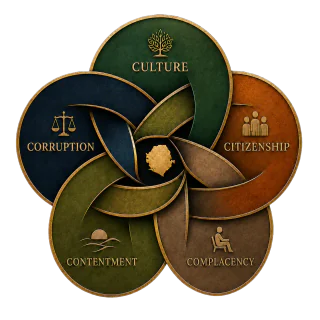
PART ONE · THE FIVE C THEORY
Culture
The complete introduction to Part One, adapted for web reading from The Five C Theory.
No one enters public life alone. When a person receives an appointment, wins an election, gains influence, or rises into authority, the achievement rarely belongs to that person alone. Family members celebrate, friends remember the years of struggle, and a community may see the success as proof that one of its own has finally reached a place from which others can be helped. Then the requests begin.
A relative needs employment, a friend needs an introduction, a community expects development, a political supporter believes loyalty should be recognized, and an elder reminds the new official of obligations that existed long before the appointment. Each request carries a history and may sound reasonable when considered by itself.
This is the moral world into which public power enters. The official does not cease to be a sibling, parent, cousin, friend, neighbor, party member, congregant, former classmate, or child of a particular place. Although public authority may be new, the claims of belonging are old, carrying memory, sacrifice, affection, gratitude, and expectation. That is why the relationship between culture and public life cannot be understood through easy condemnation.
Culture is not corruption. Belonging is not exclusion. Respect is not submission. Loyalty is not complicity. Generosity is not favoritism. Family obligation is not automatically incompatible with public responsibility. Yet each of these virtues contains a tension: belonging can narrow the circle of concern, respect can discourage necessary questions, generosity can become the unequal distribution of public opportunity, family obligation can place private relationships above public duty, and loyalty can protect people from the consequences of wrongdoing.
The issue is therefore not whether culture is good or bad. Culture is neither the villain in Sierra Leone’s national story nor an innocent background against which politics happens. It is the social environment in which power is understood, exercised, resisted, negotiated, and sometimes protected. It teaches people whom they owe, whom they trust, whom they defend, and whose criticism they are prepared to hear. It shapes ideas about leadership, age, authority, generosity, gratitude, status, and belonging. It influences whether public office is understood as a temporary trust held on behalf of citizens or as an achievement whose benefits should first reach the officeholder’s family, supporters, and community.
These expectations do not operate only among political leaders; they exist throughout society. A citizen may condemn favoritism in government while expecting assistance from a relative in authority. A person who demands impartial institutions may search for a private connection when confronted with a slow or unreliable process. A supporter who denounces corruption by an opposing party may become defensive when similar allegations concern a leader from his or her own side.
This is not always simple hypocrisy; it may reveal a conflict between two moral systems. The first is the morality of relationship, which teaches that good people remember those who stood beside them by helping relatives, honoring elders, rewarding loyalty, protecting their communities, and refusing to abandon friends during hardship.
The second is the morality of public responsibility. It requires officeholders to treat citizens fairly, distribute opportunities impartially, protect common resources, and prevent private relationships from determining public outcomes. Both systems contain legitimate values, but the difficulty begins when they point in different directions. A public official may believe that refusing to help a relative is a form of betrayal, while a citizen outside the family may experience the same assistance as an abuse of office. A community may celebrate a leader for directing resources toward its members, while another community may see exclusion. A supporter may describe the defense of a political leader as loyalty, while others may recognize complicity.
The same action can appear virtuous from inside a relationship and unjust from outside it. This is the central problem Part One examines: the distance between personal virtue and public justice. In private life, partiality is natural because people care more urgently for their children than for strangers, sacrifice for relatives, protect friends, and carry special duties toward those with whom they share a history.
Public office operates according to another standard. An officeholder is entrusted with authority and resources that belong not to a family, party, ethnic community, region, or circle of friends, but to the public. The duty of office extends to citizens whose names the official may never know, whose political loyalties may differ, and whose communities may have contributed nothing to the official’s rise. Public ethics therefore asks something emotionally difficult of the person in authority: recognition of the legitimate claim of the stranger.
That is one of the highest demands of democratic public life. Culture also shapes how authority is received. Respect for elders, chiefs, religious figures, professionals, political leaders, and officeholders can preserve social order and continuity. It can transmit wisdom, restrain arrogance, and remind individuals that they belong to something larger than themselves. But respect becomes dangerous when it removes powerful people from scrutiny. When disagreement is treated as insolence, misconduct gains protection. When criticism must always be softened to preserve the comfort of authority, the burden falls upon the critic rather than the person whose conduct requires examination. When the status of the speaker matters more than the truth of what is spoken, power begins to determine which facts may be acknowledged.
Respect recognizes human dignity. Silence protects power. They should not be confused. Silence is not always imposed through an official order or an open threat; it can also be produced through social expectation. People may censor themselves because they do not wish to embarrass an elder, offend a leader, appear ungrateful, betray a party, divide a family, or expose someone with whom they share an identity.
Authority does not always need to silence criticism when relationships persuade people to silence themselves. The chapters in this section trace how these pressures develop. Chapter One begins with belonging—the networks of family, friendship, religion, ethnicity, neighborhood, region, and shared history through which people find identity and support—and asks when belonging strengthens society and when it turns access into a private advantage. Chapter Two examines respect and authority, considering how deference can sustain order while discouraging questions that public life requires.
Chapter Three turns to the conflict between family obligation and public responsibility, exploring how private generosity can become public injustice when officeholders are pressured to use public authority to repay personal, communal, or political debts. Chapter Four examines the point at which loyalty becomes complicity and asks what happens when people protect wrongdoing because admitting the truth would threaten a leader, family, party, profession, institution, or community with which they identify.
Together, these chapters advance a careful argument: Sierra Leonean culture does not make corruption inevitable, nor should cultural identity be treated as an obstacle to progress. Culture contains resources for integrity as well as opportunities for manipulation; loyalty can demand honesty, respect can include principled disagreement, family honor can be tied to ethical conduct, and community solidarity can defend public resources rather than compete for private access to them.
The purpose of cultural criticism is not to strip society of its identity, but to ask which interpretations of culture serve human dignity and which protect power. A nation does not become stronger by teaching people to abandon belonging; it becomes stronger by widening the meaning of belonging until the rights of unfamiliar citizens matter alongside the needs of those closest to us.
The challenge is not to create Sierra Leoneans without loyalties, but to build a public culture in which loyalty to family, community, party, region, and tradition does not cancel the larger obligation owed to the country and to one another.
The question beneath Part One is therefore both personal and national: What do we owe the people closest to us, and what do we owe those whose only claim upon us is that they, too, are citizens?