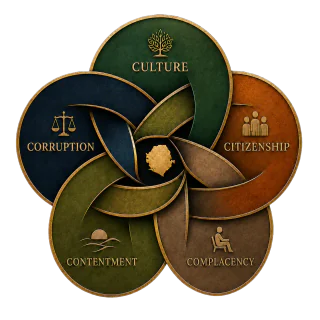
PART FOUR · THE FIVE C THEORY
Contentment
The complete introduction to Part Four, adapted for web reading from The Five C Theory.
Contentment is usually praised as a virtue because it teaches gratitude, patience, emotional balance, and the ability to value life even when circumstances are difficult, protecting people from the belief that dignity depends entirely upon wealth, status, or comfort. For Sierra Leoneans, this capacity has often been essential: people have endured war, disease, economic instability, unemployment, bereavement, displacement, and repeated institutional disappointment while preserving family, faith, humor, celebration, and social connection.
This resilience deserves respect, and a nation that has survived so much should not be criticized for learning how to live and love within imperfect conditions. Yet every virtue contains a danger when separated from judgment: contentment can become accommodation, patience can become indefinite waiting, faith can become surrender to circumstances that human beings have a responsibility to change, and adaptation can become so successful that failure no longer produces sufficient pressure for reform.
The Five C Theory therefore treats contentment neither as weakness nor as an uncomplicated virtue; it asks when contentment protects the human spirit and when it protects institutions from accountability. The distinction matters because the language of gratitude and patience often enters public life. A community receives an incomplete project and is told to appreciate that work began, an employee receives inadequate conditions and is reminded to be grateful for employment, and a young person unable to find work is told to wait because opportunity will eventually come.
Each statement may contain compassion or realism, yet together they can produce a culture of reduced expectation. Citizens begin to measure public performance not against what institutions should reasonably provide, but against how much worse conditions might have been. A dangerous road is praised because there is at least a road, a school without adequate materials is defended because children have a building, and an institution avoids scrutiny because another institution performs even worse.
Improvement matters, and perfection is not a reasonable standard, but comparison can become a method of lowering accountability. The relevant question is not only whether conditions are better than before, but whether the improvement is proportional to the time, authority, promises, and resources involved. Contentment becomes politically dangerous when partial delivery is treated as complete fulfillment.
There is dignity in knowing that life cannot be measured only by accumulation. A person may live modestly, remain grateful, and resist the social pressure to perform wealth, but personal contentment and civic contentment are different. A family can be satisfied with a simple home while still demanding clean water, just as a citizen can reject consumerism while insisting upon a functioning hospital. The dignity of enough in private life should not become permission for insufficiency in public life.
Part Four examines this tension across four chapters. Chapter Thirteen considers resilience, community, humor, generosity, and the cultural strength that helps people survive. Chapter Fourteen examines faith and patience as sources of courage that can also be used to postpone political responsibility. Chapter Fifteen distinguishes the dignity of enough from the public acceptance of deprivation. Chapter Sixteen traces the hidden cost of adaptation: the money, time, labor, stress, and inequality citizens absorb when they privately replace failing systems.
The central argument is not that Sierra Leoneans should become less grateful, faithful, patient, or resourceful, but that these qualities should not operate as unlimited subsidies to weak institutions. A people can be grateful and demanding, patient and organized, faithful and politically alert, content with personal simplicity and unwilling to accept public injustice. The strength that helps people survive should not become the excuse that allows institutions to fail.