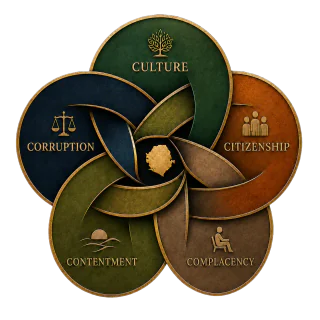
PART FIVE · THE FIVE C THEORY
Complacency
The complete introduction to Part Five, adapted for web reading from The Five C Theory.
Complacency is often misunderstood as laziness. It is easy to imagine the complacent citizen as someone who does not care, does not work, and does not understand the seriousness of national problems. That image is convenient because it places failure entirely upon the individual. Yet complacency can exist in people who work extremely hard: a trader may rise before dawn and still believe corruption cannot be challenged, a professional may perform demanding work while remaining silent about institutional abuse, and a citizen may complain passionately in private while assuming that public action will change nothing.
Complacency is therefore not always the absence of effort; it is often the surrender of expectation. People continue living, working, praying, voting, trading, educating children, and building private futures, but what disappears is the conviction that public institutions can be made to answer. The citizen does not necessarily approve of failure; instead, the citizen begins to organize life around the belief that failure is permanent.
This surrender often sounds like realism. People say that nothing will happen, that all politicians are the same, that the system is too strong, that one person cannot fight government, and that the safest course is to find a private solution. These statements may contain hard-earned wisdom. Citizens have watched investigations disappear, promises remain unfulfilled, projects stall, officials return after scandal, and people suffer for speaking while others prosper through silence. Repeated disappointment teaches caution, and the Fifth C emerges when caution becomes a complete political philosophy.
Contentment and complacency are related but distinct: contentment can preserve dignity, faith, gratitude, humor, and emotional balance under conditions that cannot be changed immediately, while complacency begins when acceptance settles over public failure. The citizen no longer says, “I will protect my peace while continuing to demand change.” The citizen says, “There is no point demanding anything.” Contentment protects the person from despair. Complacency protects the institution from consequence.
Every society carries an idea of what is normal: in a strong civic culture, an unfinished road, unexplained appointment, missing medicine, absent teacher, or abandoned project produces sustained pressure, while in a complacent culture the same failure becomes familiar. People notice it, discuss it, joke about it, and adapt to it, but the issue does not remain alive long enough to force an answer. Failure becomes invisible not because it disappears, but because it becomes ordinary.
The belief that nothing will change does not appear from nowhere. A citizen reports a problem and receives no response, a community writes letters and hears nothing, an investigation is announced but never concluded publicly, and an official accused of wrongdoing reappears in another role. Each event teaches a lesson, and eventually that lesson expands from one failed effort into a judgment that effort itself is pointless. Power benefits when citizens stop expecting answers before power has even refused them.
Part Five examines this process in four movements. Chapter Seventeen asks when acceptance becomes surrender. Chapter Eighteen explores the psychology of “nothing will change,” including fear, exhaustion, cynicism, and learned helplessness. Chapter Nineteen examines the normalization of failure within institutions and public culture. Chapter Twenty turns to the comfort of private complaint and the distance between political understanding and organized civic action.
Complacency is the final C because it stabilizes the other four: culture can encourage loyalty and silence, corruption creates private routes around public rules, weak citizenship reduces the expectation that power must answer, contentment and adaptation make institutional failure survivable, and complacency persuades people that resistance is pointless. Breaking the cycle therefore requires more than exposing wrongdoing or changing leaders; it requires restoring credible evidence that participation, persistence, and public standards can produce an answer.