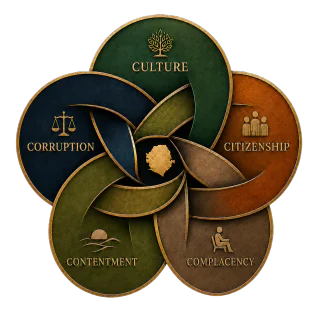
Explore the Five C Theory
Five Cs. Relationships We Can Examine.
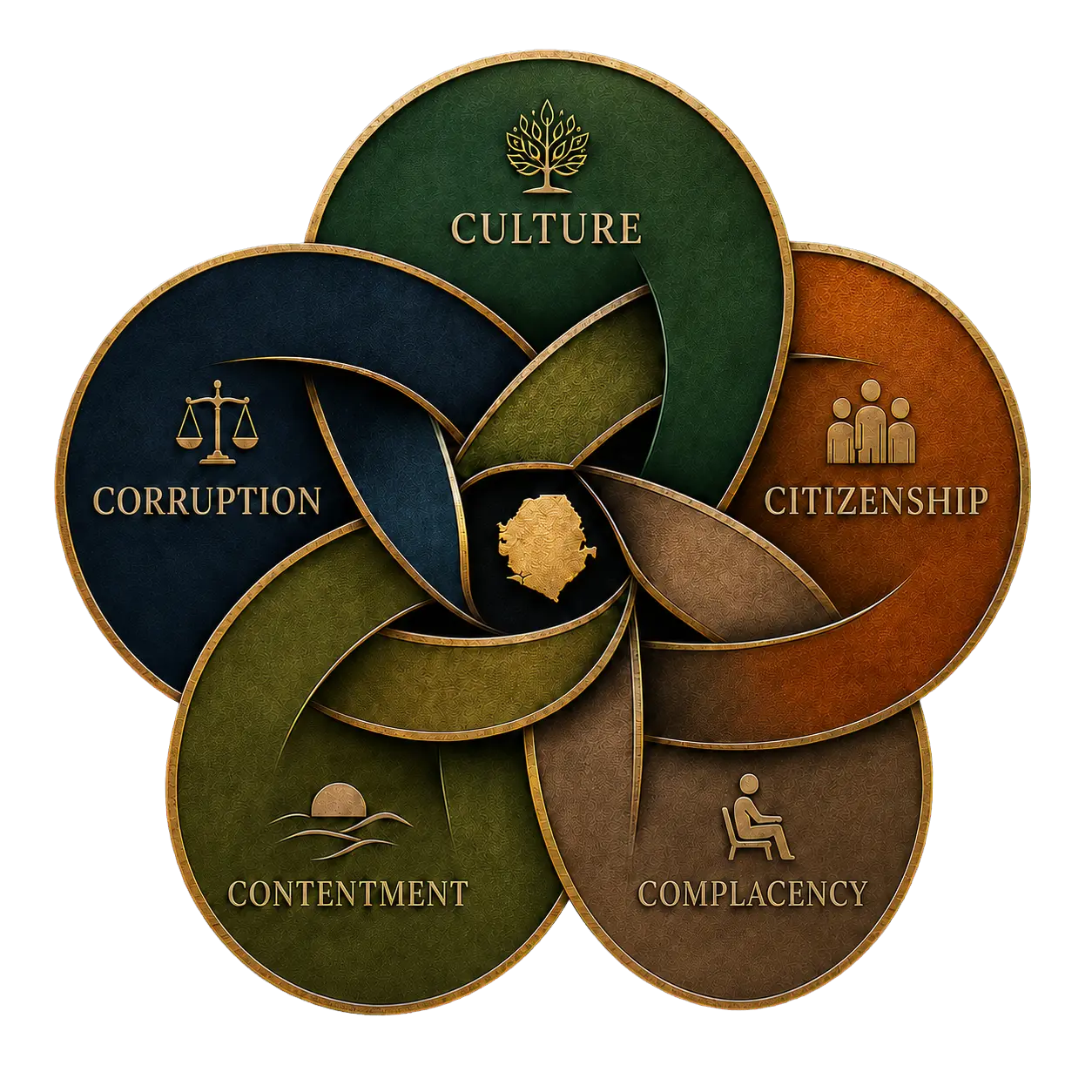
Culture, Corruption, Citizenship, Contentment, and Complacency name five domains of Sierra Leonean public life. The framework examines relationships among people, institutions, incentives, and public standards. It is a work of civic interpretation, open to evidence and counterexamples.
Culture
Belonging, respect, family obligation, and loyalty sustain community. They become harmful when private claims displace the fair treatment owed to unfamiliar citizens.
Corruption
Corruption extends beyond cash to manipulated opportunities, conflicts of interest, selective enforcement, and protection of allies. Responsibility grows with power and realistic alternatives.
Citizenship
Citizenship asks whether a decision is fair, explained, and available under the same standard to allies and opponents. A person can move among citizen, supporter, client, and subject postures.
Contentment
Contentment values life without endless accumulation. It differs from resilience and adaptation. A modest, meaningful life remains compatible with demanding safe schools, reliable services, and accountable government.
Complacency
Complacency normalises an inadequate public standard. Fear, exhaustion, strategic withdrawal, and doubt about a particular campaign do not establish complacency by themselves.
Breaking the cycle
The Five Cs reinforce one another, but they do not have to determine Sierra Leone’s future.
Culture can become public solidarity. Corruption can be challenged through transparent and accountable institutions. Citizenship can become active and equal membership. Contentment can restrain greed without lowering expectations. Complacency can be replaced by disciplined public action.
The theory is not a final judgment on the country. It is a framework for understanding where the cycle can be interrupted—and how citizens, leaders, institutions, families, professionals, and communities can begin the work of national renewal.
Explore Breaking the CycleRead the distinctions carefully
Culture is not corruption. Respect is not silence. Contentment is not complacency. Adaptation is not consent. A citizen who cannot act safely may still judge an institution’s failure clearly. Responsibility must be assessed in relation to power, knowledge, protection, and realistic alternatives.
Test the framework
Which public standard is being displaced? Who benefits and who bears the cost? What relationship protects the arrangement? What evidence would show improvement—or show that a different explanation fits better?
The Five Cs do not replace history, political economy, public finance, institutional capacity, or the effects of war and unequal opportunity. Nor does a useful illustration establish how frequently a practice occurs.
Explore practical civic actionInside the 2026 edition
The Five C Theory examines how culture, corruption, citizenship, contentment, and complacency interact in Sierra Leonean public life—and how equal citizenship and accountable institutions can interrupt public failure.
Read the complete chapter contents
- AUTHOR’S NOTE
- PREFACE
- INTRODUCTION: The Country We Accept
- PART ONE: Culture
- CHAPTER ONE: The Power of Belonging
- CHAPTER TWO: Respect, Authority, and Silence
- CHAPTER THREE: Family Obligation and Public Responsibility
- CHAPTER FOUR: When Loyalty Becomes Complicity
- PART TWO: Corruption
- CHAPTER FIVE: Corruption Beyond the Brown Envelope
- CHAPTER SIX: The Politics of Patronage
- CHAPTER SEVEN: Survival Inside a Corrupt System
- CHAPTER EIGHT: Why Accountability So Often Fails
- PART THREE: Citizenship
- CHAPTER NINE: Citizen, Supporter, Client, or Subject?
- CHAPTER TEN: The Meaning of Public Service
- CHAPTER ELEVEN: Ethnicity, Region, Party, and Nation
- CHAPTER TWELVE: Reclaiming the Civic Imagination
- PART FOUR: Contentment
- CHAPTER THIRTEEN: The Strength That Helps Us Survive
- CHAPTER FOURTEEN: Faith, Patience, and Political Power
- CHAPTER FIFTEEN: The Dignity of Enough
- CHAPTER SIXTEEN: The Hidden Cost of Adaptation
- PART FIVE: Complacency
- CHAPTER SEVENTEEN: When Acceptance Becomes Surrender
- CHAPTER EIGHTEEN: The Psychology of “Nothing Will Change”
- CHAPTER NINETEEN: The Normalisation of Failure
- CHAPTER TWENTY: The Comfort of Private Complaint
- AFTER THE FIVE Cs: Breaking the Cycle
- CHAPTER TWENTY-ONE: Citizenship Reclaimed
- CHAPTER TWENTY-TWO: Building a Culture of Accountability
- CHAPTER TWENTY-THREE: From Private Frustration to Public Action
- CHAPTER TWENTY-FOUR: The Sierra Leone We Must Refuse to Abandon
- ACKNOWLEDGEMENTS
- NOTES
- A NOTE ON SOURCES AND METHOD
- DISCUSSION GUIDE
- A CALL TO THE READER
- ABOUT THE AUTHOR