Read with one question in view.
This short guide does not replace the essay. It helps you test its argument and leave with a responsible next step.
- Ask
- When I condemn public failure, do I apply the same standard when the person involved is from my party, family, region, workplace, or social network?
- Distinguish
- Distinguish understandable personal survival within weak systems from the repeated private exceptions that help keep those systems unequal.
- Apply
- Move one concern beyond complaint: record it carefully, raise it through a lawful collective channel, follow it over time, and judge progress by evidence rather than promises alone.
Contentment · 8 min read
Why Public Outrage So Often Fails to Produce Public Change
In Sierra Leone, public anger is often abundant while durable reform remains difficult. The problem is not a failure to notice injustice; it is the failure to convert complaint into consistent citizenship, organized pressure, and institutions that serve the public rather than private connections.
By Bhai-Dhawa Sesay · July 31, 2026 · Five C InsightCentral claim
Public outrage produces little lasting change when it remains an emotional response rather than becoming ethical consistency, organized citizenship, sustained institutional pressure, and cultural expectations that place public duty above private access.
The gap between anger and change
In Sierra Leone, public frustration is rarely difficult to find. Concerns about corruption, weak institutions, poor public services, political favoritism, unemployment, rising costs, and unequal opportunity circulate through homes, markets, offices, poda-podas, radio programmes, community meetings, and social-media conversations.
That public awareness matters. It shows that citizens can recognize when a service is failing, when access is unequal, or when public authority appears to be used for private advantage. Yet recognition is not the same as reform. Anger may rise quickly, spread widely, and then disappear without altering the practices, incentives, or institutions that made the problem possible.
The central difficulty, then, is not simply that people are silent or uninformed. It is that outrage is often left in its most temporary form: a reaction. It may release frustration, expose a problem, or embarrass an official. But by itself it does not create records, build collective capacity, sustain attention, or establish a standard that applies even when wrongdoing benefits people close to us.
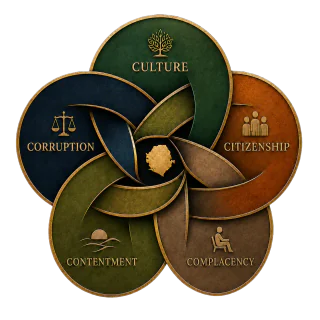
The Five C Theory offers a way to understand this gap. Culture, Corruption, Citizenship, Contentment, and Complacency are not presented as five separate defects with five easy remedies. They are interconnected forces. They can create a pattern in which people condemn public failure in principle while accommodating it in private practice. In that pattern, the system survives not only because of what powerful actors do, but also because of what ordinary citizens learn to expect, excuse, seek, or tolerate.
Culture: the unwritten rules behind public conduct
Culture includes more than language, ceremony, food, dress, and tradition. It also includes the unwritten rules through which people understand authority, respect, loyalty, success, obligation, and belonging. These rules can be a source of moral strength. The essay identifies communal care, hospitality, resilience, responsibility to relatives, and collective responsibility as values that can support accountability and the public good.
But the same social world can produce a conflict between formal rules and informal expectations. A public institution may be expected to treat citizens equally, while an official may be pressured to give special access to relatives, associates, party members, or people from a shared region or network. When an official refuses such a request, that person may be seen as unhelpful. When an official grants it, the action may be praised as generosity.
This is not an argument that Sierra Leonean culture is inherently corrupt. The essay explicitly rejects that conclusion. Culture is not fixed as either good or bad; its values can be directed towards public responsibility or used to excuse conduct that harms it. The question is whether loyalty to a person is permitted to outweigh responsibility to the public.
That question is demanding because it reaches beyond the conduct of leaders. It asks citizens to notice when a request for help becomes a request for an unfair exception. It asks communities to honour integrity even when integrity denies someone preferential treatment. A culture of accountability cannot be built only by condemning visible misconduct. It must also make fairness socially respectable when fairness is inconvenient.
Corruption as an alternative system of access
Corruption is often pictured as a secret exchange of money. The essay asks readers to see a wider field: access, protection, employment, contracts, silence, influence, selective enforcement, and the expectation of future favours can also become forms of corrupt exchange. What joins these practices is not only money, but the conversion of public authority or public opportunity into private advantage.
When such exchanges become normal, corruption ceases to appear exceptional. It begins to function as an alternative system of administration. People may come to believe that official procedures are less reliable than a personal connection, and that a right is not truly available unless someone influential can help secure it.
Here the essay identifies a destructive cycle. Weak institutions encourage citizens to rely on connections. Reliance on connections further weakens institutions because it makes equal procedures less meaningful. Each private exception can make the next citizen’s claim to fair treatment more difficult. The person who uses a connection may describe the choice as survival: if they do not use it, someone else will. That reasoning can be understandable in a difficult setting, but repeated across society it helps reproduce the injustice that people publicly denounce.
This diagnosis does not distribute blame equally between those with power and those trying to survive systems that do not serve them fairly. It does, however, insist that corruption cannot be understood only as wrongdoing imposed from above. It can be renewed through many smaller choices: paying to avoid a process, requesting special treatment, protecting misconduct because the offender belongs to one’s group, or remaining silent in expectation of later access.
The implication is uncomfortable but important. Reform must address both institutional weakness and the social usefulness of connections. A rule is not fully protected merely because it exists. It must be supported by expectations that make equal treatment more valuable than the private favour.
Citizenship beyond the ballot box
The essay challenges a narrow understanding of citizenship as nationality, election-day voting, or loyalty to a political party. In its fuller sense, citizenship is a continuous relationship between an individual and the public good. It includes rights, but also responsibilities: seeking reliable information, questioning leaders consistently, respecting public property, participating in community life, rejecting favoritism, and applying ethical standards to allies as well as opponents.
The problem with partisan citizenship is not that citizens belong to parties, families, regions, or communities. Such identities are real and meaningful. The problem begins when accountability changes according to who is in office or who is accused. Conduct condemned under one government may be defended under another. Evidence may be welcomed when it harms an opponent and dismissed when it implicates an ally.
The essay calls this political loyalty wearing the language of principle. Its test is simple, though difficult to meet: if corruption is wrong, it remains wrong when committed by someone we support; if abuse of power is dangerous, it remains dangerous when the officeholder shares our background. Without that consistency, elections may replace officeholders while leaving the habits of public life untouched.
Outrage becomes more useful when citizens turn it into disciplined activity. The essay proposes documented, lawful, sustained collective action rather than isolated emotional reaction. Communities can track promises, request public information, attend consultations, support responsible journalism, protect whistleblowers, and preserve records beyond the immediate news cycle. These actions do not guarantee a result. Their value is that they make it harder for public concerns to disappear once the excitement has passed.
Institutional citizenship also shifts attention from the hope for one good leader to the demand for systems that work regardless of who occupies an office. Procurement systems, courts, councils, schools, public agencies, and oversight bodies matter because public life cannot depend entirely on individual virtue.
When contentment becomes accommodation
Contentment is not naturally an obstacle to public change. It can protect people from destructive envy and provide dignity, gratitude, and peace amid hardship. The essay’s concern is with a different use of contentment: the point at which endurance becomes an excuse for low expectations of institutions.
A population that has learned to survive difficult conditions may tolerate services that should be challenged. An incomplete project may be celebrated simply because something was started. A small improvement may be treated as a reason to stop asking whether public work was completed competently, transparently, and fairly. In this way, resilience can be exploited. The capacity to endure failure can become a reason for institutions to continue producing it.
The necessary distinction is between gratitude and approval. Citizens can recognise progress without pretending that effort is the same as results. They can appreciate a beginning while asking whether commitments were fulfilled. They can reject cynicism without accepting inadequate performance as normal.
This matters because public expectations shape public standards. If communities are told that they should be grateful for any service at all, then equality, quality, transparency, and completion are made to seem excessive demands. The essay argues instead that high expectations are compatible with gratitude. Responsible citizenship occupies the difficult space between hopelessness and false optimism: it acknowledges what has improved, documents what has failed, and continues to demand better.
Complacency and the illusion of participation
Complacency begins when people no longer expect their actions to matter. It can appear in statements such as, “Nothing will change,” “They are all the same,” or “This is how the country works.” Such conclusions may grow from genuine disappointment after repeated promises, scandals, investigations, campaigns, and leadership changes fail to produce the transformation people expected.
The essay does not dismiss that disappointment. It identifies its consequence: withdrawal gives organized interests more room to operate. When citizens cease attending meetings, asking questions, recording failures, or supporting independent institutions, power faces less scrutiny.
Complacency is not always quiet. A person may complain constantly and still do nothing that challenges the continuation of the problem. Complaint can become a substitute for participation: it releases emotion without creating organization, evidence, strategy, or sustained pressure. This is why the essay’s distinction is so sharp: outrage is emotional; citizenship is disciplined.
Discipline does not mean that every citizen must become an activist, expert, or public spokesperson. It means recognising that a complaint has a further life beyond conversation. It can be checked, documented, shared responsibly, raised through an appropriate lawful forum, and followed over time. It can also be tested against the same standard whether it concerns a friend or an opponent. These are modest but meaningful ways of refusing the belief that nothing can matter.
Breaking a reinforcing system
The Five Cs form a circular pattern. Culture can normalise personal loyalty over public duty. That normalisation can make corruption easier to justify. Corruption weakens institutions and teaches citizens that connections matter more than rights. Weak citizenship allows lower expectations to grow. Contentment is then used to rationalise inadequate performance. Repeated disappointment produces complacency, which protects the habits that began the cycle.
This account explains why a single reform is unlikely to be sufficient. New laws have limited effect if informal expectations continue to reward exceptions. Elections have limited effect if citizenship begins and ends at the ballot box. Anti-corruption campaigns have limited effect if citizens condemn misconduct selectively. Public education has limited effect if institutions punish integrity and reward connections.
The essay therefore calls for change across the relationship between citizens, culture, and institutions. Its proposed starting points are ethical consistency, organization, institutional citizenship, and cultural renewal. Cultural renewal does not mean rejecting Sierra Leone’s culture. It means elevating values within it that support public responsibility: communal care, moral courage, respect for integrity, protection of future generations, and an understanding that leadership carries obligations.
The central question is not only why leaders fail. It is also what patterns allow failure to survive, and what responsibility each person has for interrupting them. That question should not become a way to excuse powerful actors or transfer institutional responsibility onto citizens. Rather, it makes clear that public change requires pressure from more than one direction: institutions must function fairly, leaders must be accountable, and citizens must refuse the everyday accommodations that make failure easier to preserve.
A necessary caution: citizens cannot carry the whole burden
The emphasis on personal responsibility has an important limitation. People living with weak services, unequal access, and economic pressure may use personal networks because formal systems have already failed them. It would be unfair to treat every act of reliance on family, friends, or community as identical to the abuse of public power by those with influence.
The essay itself recognises that survival reasoning may be understandable. Its argument is not that citizens alone cause corruption or institutional failure. Nor is it that moral exhortation can substitute for effective laws, fair procedures, independent oversight, or consequences for abuse.
The stronger interpretation is that reform requires both institutional responsibility and civic consistency. Citizens should not be asked to endure injustice in the name of virtue, while those with authority escape scrutiny. At the same time, institutional reform will remain fragile if society continues to celebrate private exceptions and excuse wrongdoing on the basis of affiliation. The task is to hold both truths together without simplifying either.
What this diagnosis asks of public life
For citizens, the implication is to make accountability less selective. Before defending or dismissing an allegation, ask whether the response would be the same if the people involved belonged to another party, family, region, or network. Support public discussion that is evidence-seeking rather than merely insulting, and move concerns from private complaint toward collective, lawful follow-up.
For communities and civic groups, the implication is to preserve memory. Track commitments, maintain records, attend public forums where possible, and support practices that keep an issue visible after attention moves elsewhere. Organized pressure is not only louder than individual anger; it is more capable of showing what was promised, what occurred, and what remains unresolved.
For institutions and leaders, the implication is that public trust cannot be secured through appeals for patience alone. Trust depends on procedures that do not require personal access, and on conduct that makes integrity safer than favouritism. The essay’s standard is not perfection. It is a public order in which rights matter more than connections and progress can be assessed without surrendering the right to ask difficult questions.
Responsible next step
Choose one local public concern and, with others where possible, turn it into a simple evidence-based record: what was promised or required, what has been observed, which lawful public channel can receive the concern, and when the issue will be reviewed again. Apply the same standard regardless of political or personal affiliation.
Sources and verification
- Public anger alone does not produce lasting reform unless it is converted into organized citizenship, institutional pressure, ethical consistency, and sustained participation. — This is the essay’s central stated argument. (supported by essay)
- The Five Cs operate as a reinforcing cycle rather than isolated problems. — The supplied essay explicitly describes the circular relationship among Culture, Corruption, Citizenship, Contentment, and Complacency. (supported by essay)
- Reliance on connections can emerge as a survival response where formal institutions are unreliable. — The essay presents this as an understandable reasoning within weak systems, not as a verified empirical measure. (supported by essay)
- No single reform can permanently break the cycle. — The essay states that no single reform will break the system permanently; the draft treats this as a framework-level conclusion rather than a universal factual prediction. (interpretation)
- Public institutions in Sierra Leone currently punish integrity and reward connections. — The essay uses this as a conditional warning about why public education may have limited effect. It should not be presented as an unqualified factual description without independent evidence. (needs verification)
Corrections
Readers who identify a misreading, unsupported factual implication, or missing qualification should submit the specific passage and proposed correction to The Five C Theory editorial team for human review against the original essay.
Continue This Inquiry
- Five C introduction: How informal expectations of loyalty can coexist with, or undermine, equal public treatment.
- Practical resource: A community promise-tracking template that separates commitments, evidence, responsible bodies, follow-up dates, and unresolved questions.
- Next reading or action: Explore how to make accountability standards consistent across party, family, regional, and social-network loyalties.
These are topic suggestions for further inquiry, not references to existing pages, resources, or publications.