- Brief
- Behind the Theory
- Author
- Bhai-Dhawa Sesay
- Reading time
- 3 minutes
- Published
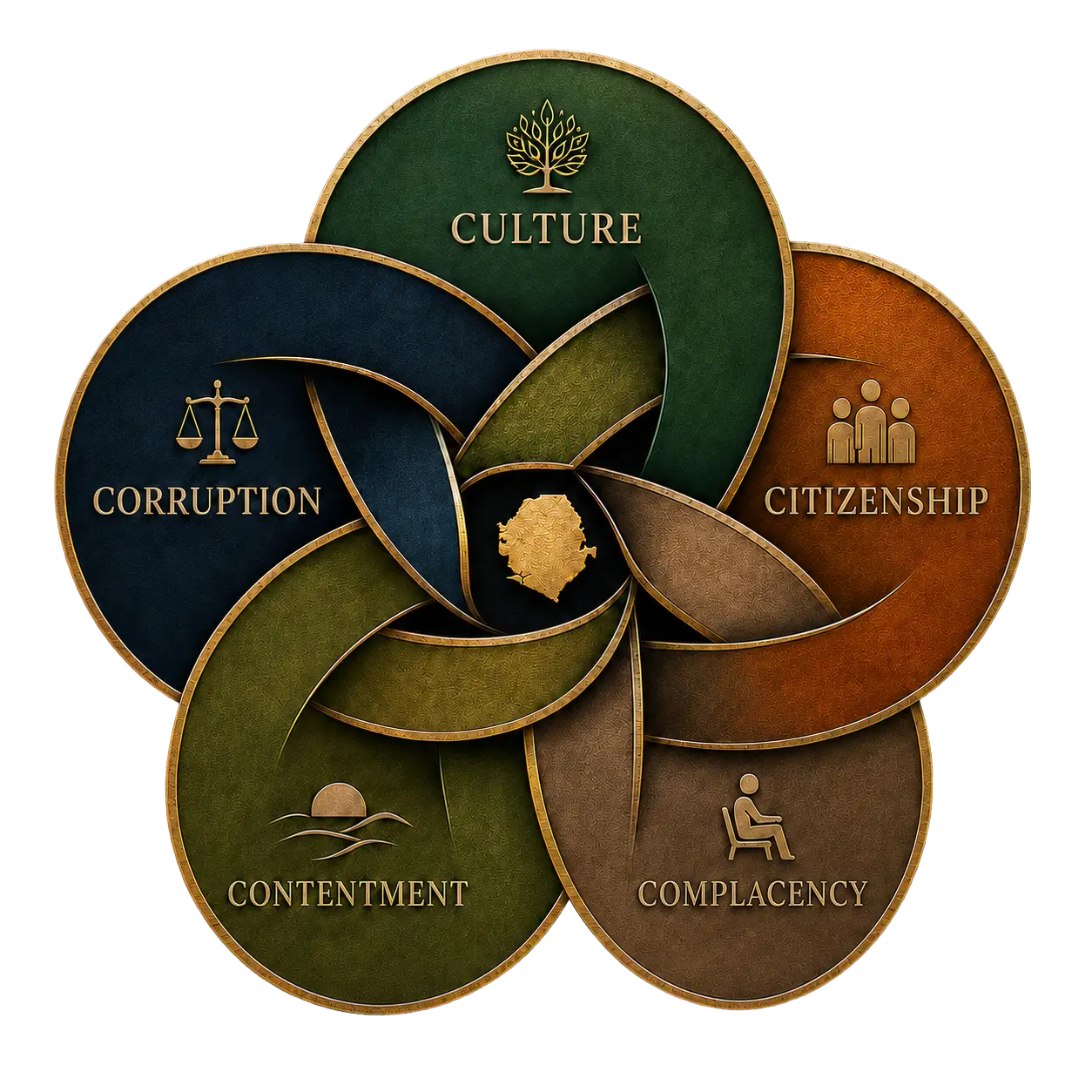
A durable framework is not produced by naming five problems. It emerges by testing the relationships among them across time, institutions, and lived experience.
Observation came before terminology
The Five C framework developed gradually. Long before the five-part structure became clear, I was observing how people moved between private loyalty and public obligation, how citizens experienced institutions, how survival shaped expectation, and how repeated disappointment changed what communities believed was possible.
Those observations came through life in Sierra Leone and the United States, through technology and media work, through public discussion, and through decades of watching systems promise change while familiar habits reorganized themselves around the new language.
The framework had to explain interaction
A list of social problems is easy to produce. The more difficult task is to explain interaction without pretending that every case is the same. Culture can influence the way access is negotiated. Corruption can weaken confidence in equal rules. Weak citizenship can make public institutions feel distant or privately owned. Contentment can help people preserve dignity while lowering institutional expectations. Complacency can turn repetition into normality.
No single sequence explains every event. The framework is a disciplined way to ask what is operating, what is reinforcing what, who carries responsibility, what evidence is missing, and where interruption may be possible.
Testing the language
Each term carries risks. Culture can be used lazily as an explanation for anything. Corruption can become an accusation without evidence. Citizenship can be reduced to voting or nationality. Contentment can be confused with weakness. Complacency can become a judgment about people who are surviving conditions they did not create.
The book therefore treats definition and distinction as part of the argument. It asks readers to separate a cultural value from its misuse, a corrupt act from a structural vulnerability, legal membership from practiced citizenship, dignified adaptation from institutional surrender, and understandable fatigue from the normalization of avoidable harm.
A framework remains accountable to evidence
The Five C Theory is an interpretive framework, not a substitute for case-specific evidence. It cannot prove that a person acted from a particular motive or that one national outcome has a single cause. It should guide inquiry, not end it.
That is why the website separates Blog updates, reviewed Insights, practical resources, and publication records. Different kinds of writing require different levels of evidence and review. The framework becomes more useful when its own claims remain open to correction, clarification, and responsible disagreement.
Read the five introductions in sequence.
The account-free reading journey records optional progress only on the current device and helps readers return to the next Five C.
Open My Reading Journey
Keep reading
Continue with the Blog
How an Insight Moves from Draft to Verified Publication
A transparent look at the Five C editorial workflow from source material to a verified public Insight.
Read articleCitizenship Begins Where the State Is Felt
A reflection on why local participation matters—not as permanent confrontation, but as the disciplined work of turning broad frustration into specific, answerable public questions.
Read article