- Brief
- From the Author
- Author
- Bhai-Dhawa Sesay
- Reading time
- 3 minutes
- Published
- Updated
The book began with a persistent question: why do familiar national problems survive repeated moments of hope, outrage, reform, and political change?
The question beneath the headlines
I did not begin The Five C Theory because Sierra Leone lacked opinions about its problems. We have never lacked explanation, criticism, promises, intelligence, or courage. What remained unresolved for me was the pattern underneath the individual crisis: the habits that allow one public failure to survive after another, even when the people involved, the institutions, and the language of reform change.
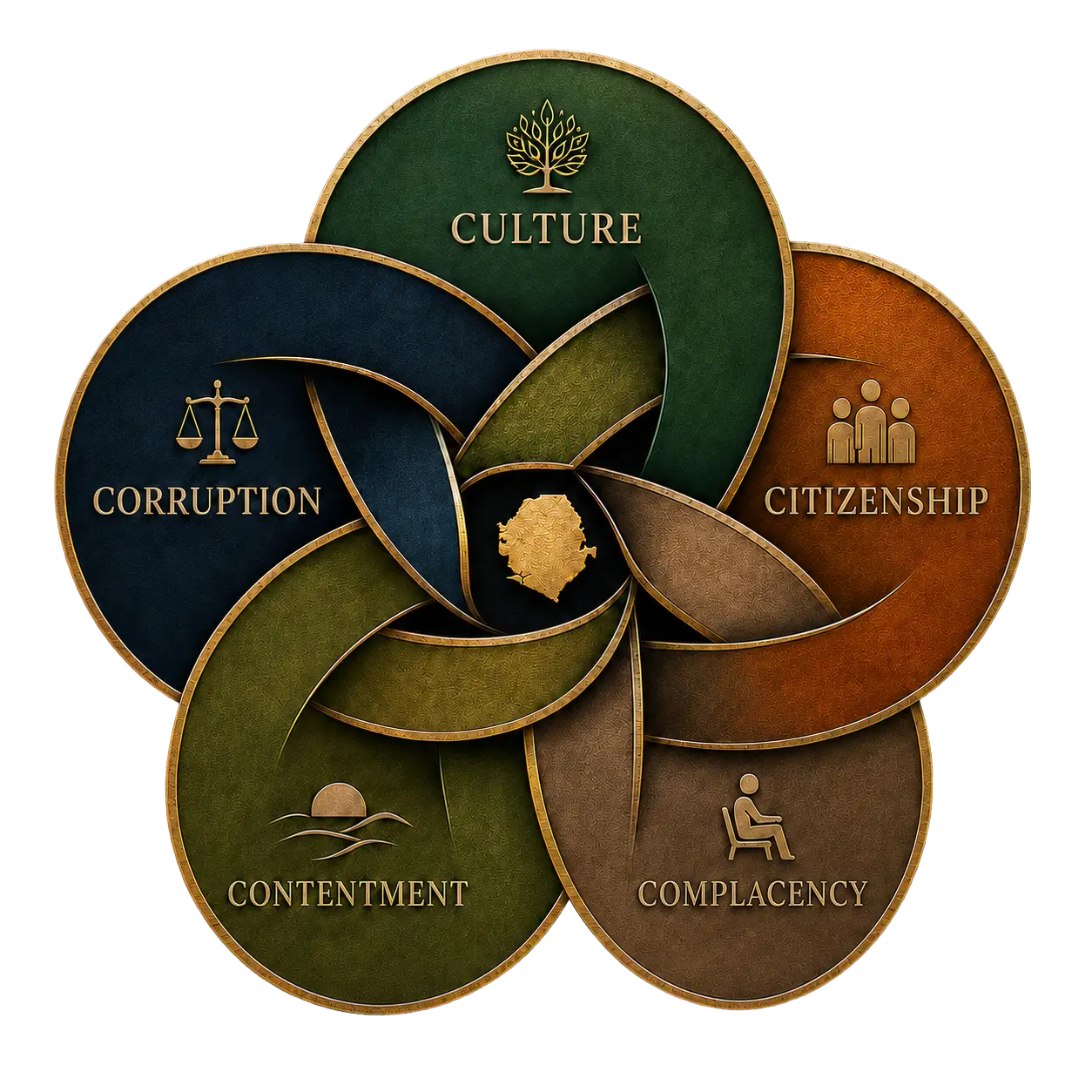
Corruption was part of that pattern, but corruption alone could not explain it. A transaction happens inside a culture. A public institution responds to the kind of citizenship people practice and expect. Communities learn to survive disappointing systems. Endurance can become contentment with what should remain unacceptable. Repetition can then become complacency—not because people do not care, but because the cost of caring has become exhausting.
Five forces, one reinforcing system
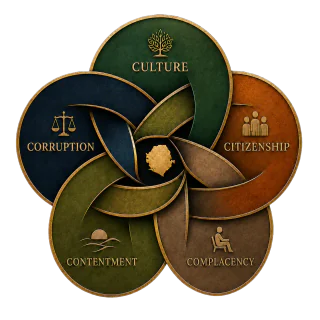
The Five Cs—Culture, Corruption, Citizenship, Contentment, and Complacency—are not five unrelated accusations. They are a map for examining relationships among belonging, access, public duty, adaptation, and tolerated failure. The framework asks us to look beyond a single bad actor and study the conditions that make the conduct repeatable.
That distinction matters. A framework should help people ask better questions, not provide a slogan for blaming a country or its citizens. Culture contains inheritance, beauty, solidarity, memory, and survival. Citizenship contains rights and duties. Contentment can protect dignity. The problem arises when a strength is redirected in a way that weakens equal public standing or reduces the pressure for systems to improve.
A book about responsibility, not despair
The purpose of this work is not to persuade Sierra Leoneans that the country is beyond repair. It is to show that persistent problems have relationships, and relationships can be interrupted. If a pattern is learned, reinforced, rewarded, or tolerated, it can also be named, examined, and changed.
Responsibility therefore belongs at every level: the citizen asking a public question, the family negotiating private obligation, the professional protecting a standard, the institution designing fair access, the leader accepting scrutiny, and the community refusing to normalize what harms the public good.
Why I am opening the work before publication
The book remains in prepublication, but the conversation does not need to remain closed. This website provides the framework introductions, selected essays, practical resources, and a free excerpt so readers can test the questions for themselves. It also records corrections and publication status openly.
I want the launch of The Five C Theory to begin with understanding rather than promotion alone. A book can introduce the map. Readers, educators, institutions, journalists, communities, and citizens will determine whether the map helps them see and act with greater clarity.
Follow the book as the public work develops.
The Five C Dispatch request can include publication news, essays, resources, podcast and video releases, and confirmed events.
Request project updates
Keep reading
Continue with the Blog
Preparing The Five C Conversation Podcast
The format, accessibility standard, and editorial direction being prepared for The Five C Conversation podcast.
Read articleHow an Insight Moves from Draft to Verified Publication
A transparent look at the Five C editorial workflow from source material to a verified public Insight.
Read articleHow Educators and Book Clubs Can Use The Five C Theory
Practical, open-access ways for educators and book clubs to begin using the Five C framework before publication.
Read article