PART THREE · THE FIVE C THEORY
Citizenship
The complete introduction to Part Three, adapted for web reading from The Five C Theory.
A country may possess citizens in law while producing subjects in practice. The distinction does not depend only upon elections, passports, identity cards, or constitutional language. A person may be legally recognized as a citizen and still relate to public authority as someone who must plead, obey, wait, flatter, depend, or seek protection from a powerful individual. The law may describe the person as an equal member of the republic, while daily experience teaches that access depends upon connections and that criticism carries risk.
Citizenship is therefore more than nationality; it is a reciprocal relationship among the individual, the state, and the wider political community. The state owes citizens rights, equal treatment, security, and institutions that can be questioned, while citizens owe the public lawful conduct, participation, care for common resources, and a willingness to judge leaders by standards larger than private or partisan interest. Citizenship weakens when either side demands loyalty without accepting responsibility.
In practice, citizenship competes with other political identities. The supporter sees public life primarily through allegiance and asks whether a decision strengthens a preferred party or leader. The client depends upon a patron for access and asks which relationship can solve the immediate problem. The subject experiences authority as something above rather than delegated and assumes that ordinary people must adjust to whatever power decides. The citizen asks different questions: Was the decision fair? Was public money used properly? Were people treated equally? Would I defend the same conduct if the other party had done it?
These identities can exist inside the same person. Someone may behave as a citizen when examining local spending, as a supporter when defending a favored government, and as a subject when dealing with an official who controls employment or access. The purpose of the distinction is not to label people permanently, but to reveal the political posture a person occupies at a particular moment and the incentives that make that posture seem rational.
Elections alone do not create active citizenship. They allow citizens to choose representatives, but what happens before and after the vote determines whether citizenship is substantive or ceremonial. A ceremonial citizen is mobilized for rallies, slogans, colors, and voting, then expected to withdraw while budgets are prepared, contracts awarded, officials appointed, and institutions reshaped. Political leaders may prefer this form of participation because it supplies legitimacy without sustained accountability.
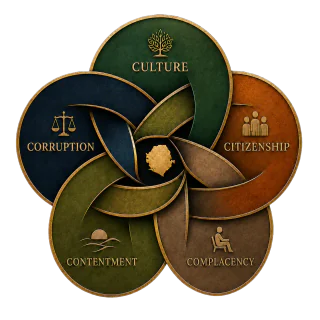
The Five C Theory places citizenship at the center because it is the principal counterforce within the book: strong citizenship widens belonging beyond family, party, region, and ethnicity. It turns respect into mutual recognition, requires officials to distinguish personal relationships from public duties, and demands accountability even when wrongdoing benefits one’s own side. Citizenship does not remove culture or loyalty; it disciplines them through public principle.
The chapters that follow examine four dimensions of that task. Chapter Nine asks whether people encounter power primarily as citizens, supporters, or subjects. Chapter Ten turns to public office and argues that service is stewardship rather than ownership. Chapter Eleven examines ethnicity, region, party, and nation, asking whether legitimate communal identities can coexist with equal national citizenship. Chapter Twelve considers civic imagination: the ability to believe that fair, competent, and responsive institutions can be built, measured, and defended.
Together, these chapters ask what it means to be a citizen in a country where power is often experienced through relationships, patronage, and political identity. The answer cannot remain legal or symbolic; citizenship becomes visible when people judge their own leaders honestly, when public officials explain their decisions, when communities defend the rights of outsiders, and when citizens refuse to confuse government with country, support with submission, or criticism with betrayal.