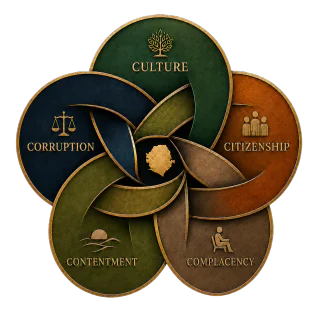
PART FOUR · THE FIVE C THEORY
Contentment
The complete introduction to Part Four, from the 2026 edition of The Five C Theory.
Contentment protects the ability to value one’s life without making accumulation the measure of its worth. Its central question is what can be enough for a person without becoming an excuse for an institution to provide too little. Resilience is the capacity to endure or recover; adaptation is the practical work of responding to difficult conditions. These are distinct from contentment, though people may draw on all three in the same life.
The distinction matters because a person can be content and still demand reform. A family may choose a modest life while expecting clean water, safe roads, competent health care, and fair treatment. Personal sufficiency is not permission for public neglect.
The chapters belong together because the boundary between personal sufficiency and public obligation is tested in daily survival. Chapter Thirteen begins with resilience, the strength that allows people to continue. Chapter Fourteen considers how faith and patience can sustain that strength or be used to postpone a public duty. Chapter Fifteen develops contentment itself: the freedom of knowing what is enough. Chapter Sixteen follows the costs of adaptation and asks whether coping conceals institutional weakness or supplies evidence around which citizens can organise.
These strengths can sustain the civic imagination developed in Part Three. Their misuse begins when an institution treats a person’s gratitude, patience, or ability to cope as a settlement of what the institution still owes.