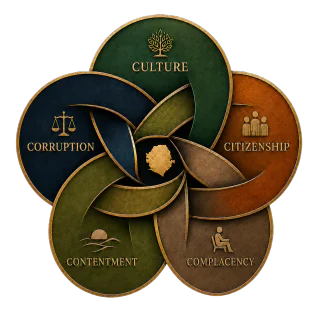
PART FIVE · THE FIVE C THEORY
Complacency
The complete introduction to Part Five, from the 2026 edition of The Five C Theory.
Complacency concerns the public standard people come to accept, not how visibly busy or politically active they appear. A person may work hard, follow public affairs, and criticise leaders while treating an inadequate institution as beyond any continuing obligation to improve.
Three conditions must remain distinct. A citizen may no longer believe power should answer. A second may believe it should answer but doubt that a particular campaign will succeed. A third may wish to act but face danger, exhaustion, or responsibilities that make participation impossible. The second and third conditions are not, by themselves, complacency.
Part Five examines the movement from living with present limits to normalising them, the loss of confidence in the connection between effort and result, the ways failure becomes ordinary, and the gap between private knowledge and public expression. These processes can reinforce one another without describing every silent or disappointed person.
The greater duty remains with those who possess the power to improve the institution, protect participation, and answer a legitimate claim. Citizens should not have to demonstrate unlimited endurance to prove that the claim remains valid.