The book
A Framework for Seeing Public Life More Clearly
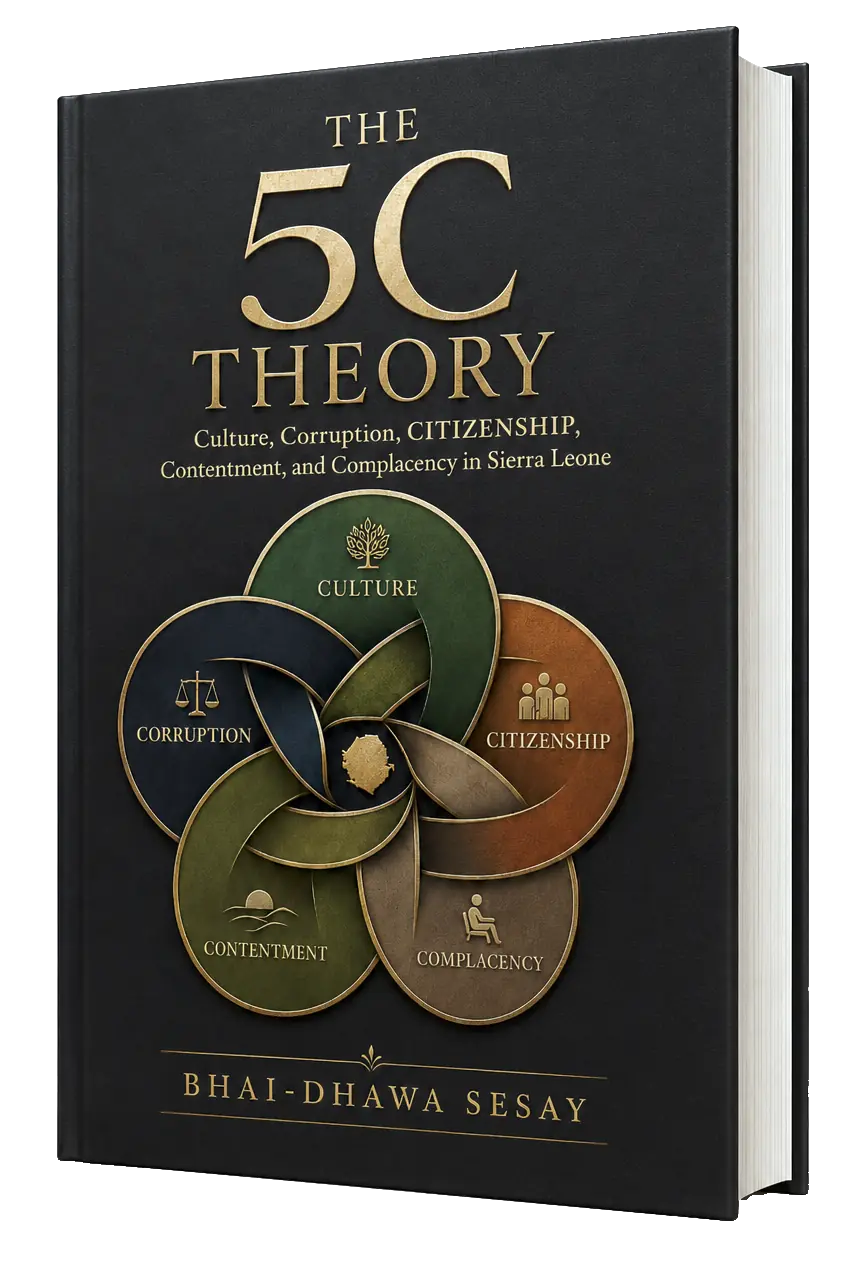
Across 24 chapters, The Five C Theory examines relationships that make public failure durable—and the civic and institutional changes that can interrupt them.
Why this book
The theory moves from diagnosis to reconstruction.
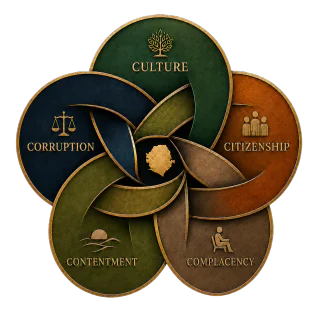
Rather than treating culture, corruption, citizenship, contentment, and complacency as separate subjects, the book studies the relationships between them. It asks not only what has gone wrong, but why familiar failures remain protected and what practical civic habits can weaken that protection.
Explore the Five C Theory
Inside the argument
The Five C Theory examines five interconnected forces that shape public life in Sierra Leone. Each part explores how these forces influence individual behavior, political institutions, social expectations, and the country’s capacity for reform.
01Part 01: Culture+
Culture gives people identity, belonging, moral responsibility, and a sense of who they owe. In Sierra Leone, family loyalty, respect for authority, communal obligation, ethnic identity, religion, and regional belonging can provide strength and social stability. But these same values can become politically dangerous when private loyalty overrides public duty.
This part examines the tension between belonging and fairness. It asks what happens when officials are pressured to help relatives, supporters, or members of their community, and when respect becomes silence in the presence of wrongdoing. The argument is not that culture must be rejected, but that its strongest values must be widened toward the public good.
02Part 02: Corruption+
Corruption is more than money exchanged secretly. It also includes patronage, favoritism, selective enforcement, hidden conflicts of interest, political interference, and the use of public authority for private benefit.
This part explores how corruption becomes embedded in everyday survival. Citizens may condemn the system while depending on personal connections to obtain services, employment, protection, or opportunity. Officials may face pressure from families, parties, and social networks, while institutions fail to protect those who follow the rules.
The result is a system in which public procedures lose credibility and private access becomes more valuable than equal citizenship.
03Part 03: Citizenship+
Citizenship should mean equal membership in the republic, but citizens are often treated—or begin to behave—as supporters, clients, dependants, or subjects.
This part asks what it truly means to be a citizen. It examines the difference between political loyalty and civic responsibility, between receiving favors and claiming rights, and between obeying authority and holding it accountable.
It also explores how ethnicity, region, party affiliation, and personal relationships shape national belonging. Reclaiming citizenship requires citizens to apply consistent standards, question allies as well as opponents, participate beyond elections, and see public institutions as something they collectively own.
04Part 04: Contentment+
Contentment is the freedom to value one’s life without making endless accumulation the measure of its worth. It differs from resilience, the capacity to endure or recover, and adaptation, the practical work of managing difficult conditions.
A person can choose a modest life while expecting competent health care, clean water, safe schools, and fair treatment. Personal sufficiency does not settle a public obligation. Faith and patience can sustain civic action; their misuse begins when they are invoked to postpone a duty.
Chapters Thirteen to Sixteen examine survival, faith and power, the dignity of enough, and the hidden money, time, and labour costs of adaptation. Coping can conceal public failure or create evidence around which citizens organise.
05Part 05: Complacency+
Complacency concerns the normalisation of an inadequate public standard. It cannot be established simply by observing that someone is silent, discouraged, or not visibly protesting.
A person may still believe power should answer while doubting that a particular campaign can succeed. Another may face danger, exhaustion, or family responsibilities that make participation impossible. These conditions are not, by themselves, complacency.
Chapters Seventeen to Twenty examine acceptance and surrender, political helplessness, institutional normalisation, and the distance between private complaint and responsible public expression. The greater duty remains with those who possess the power to improve institutions and protect participation.
06After the Five Cs: Breaking the Cycle+
Chapters Twenty-One to Twenty-Four move from diagnosis to reconstruction: Citizenship Reclaimed; Building a Culture of Accountability; From Private Frustration to Public Action; and The Sierra Leone We Must Refuse to Abandon.
The practical work includes inclusive participation, shared leadership, records that survive personnel changes, safe reporting, and a reasoned institutional response. A school-roof illustration follows inspection, funding, authorisation, completed work, and verified closure. It also considers campaigns that stall or fail despite careful organisation.
The goal is to make ordinary institutions more dependable, so that the next family does not need a heroic campaign to obtain an ordinary service.
How to read the evidence
This is a work of civic interpretation. Unless identified and sourced, scenes and dialogue are illustrative rather than reports of a particular event. The notes distinguish historical findings, legal provisions, survey results, institutional reports, and conceptual research from interpretation. Readers are invited to test the framework against variation and counterexamples.
The book includes a 28-question Discussion Guide and a Call to the Reader: choose one public question, distinguish what is known from what remains uncertain, identify a responsible institution, and assess evidence and risk before acting.
Verified publication facts
The Five C Theory
Publication information maintained by Leone Connect Publishing.
- Subtitle
- Culture, Corruption, Citizenship, Contentment, and Complacency in Sierra Leone
- Author
- Bhai-Dhawa Sesay
- Publisher and official seller
- Leone Connect Publishing
- Status
- Prepublication production
- Language
- English
- Publication date
- To be announced when confirmed
- Copyright year
- 2026
Ebook
EPUB · English · First edition, 2026
ISBN: 979-8-9982321-5-2
Paperback
Print edition
Hardcover
Hardcover · English · First edition, 2026
ISBN: 979-8-9982321-4-5
Complete contents
Follow the book from diagnosis to reconstruction.
This list is published from the approved book metadata record.
- AUTHOR’S NOTE
- PREFACE
- INTRODUCTION: The Country We Accept
- PART ONE: Culture
- CHAPTER ONE: The Power of Belonging
- CHAPTER TWO: Respect, Authority, and Silence
- CHAPTER THREE: Family Obligation and Public Responsibility
- CHAPTER FOUR: When Loyalty Becomes Complicity
- PART TWO: Corruption
- CHAPTER FIVE: Corruption Beyond the Brown Envelope
- CHAPTER SIX: The Politics of Patronage
- CHAPTER SEVEN: Survival Inside a Corrupt System
- CHAPTER EIGHT: Why Accountability So Often Fails
- PART THREE: Citizenship
- CHAPTER NINE: Citizen, Supporter, Client, or Subject?
- CHAPTER TEN: The Meaning of Public Service
- CHAPTER ELEVEN: Ethnicity, Region, Party, and Nation
- CHAPTER TWELVE: Reclaiming the Civic Imagination
- PART FOUR: Contentment
- CHAPTER THIRTEEN: The Strength That Helps Us Survive
- CHAPTER FOURTEEN: Faith, Patience, and Political Power
- CHAPTER FIFTEEN: The Dignity of Enough
- CHAPTER SIXTEEN: The Hidden Cost of Adaptation
- PART FIVE: Complacency
- CHAPTER SEVENTEEN: When Acceptance Becomes Surrender
- CHAPTER EIGHTEEN: The Psychology of “Nothing Will Change”
- CHAPTER NINETEEN: The Normalisation of Failure
- CHAPTER TWENTY: The Comfort of Private Complaint
- AFTER THE FIVE Cs: Breaking the Cycle
- CHAPTER TWENTY-ONE: Citizenship Reclaimed
- CHAPTER TWENTY-TWO: Building a Culture of Accountability
- CHAPTER TWENTY-THREE: From Private Frustration to Public Action
- CHAPTER TWENTY-FOUR: The Sierra Leone We Must Refuse to Abandon
- ACKNOWLEDGEMENTS
- NOTES
- A NOTE ON SOURCES AND METHOD
- DISCUSSION GUIDE
- A CALL TO THE READER
- ABOUT THE AUTHOR
Continue by purpose
Read individually. Teach carefully. Discuss collectively.
Begin with the free excerpt
Read Chapter Twenty-One in the browser and continue with the Reflection Guide.
EducatorsPlan a unit or adoption
Explore learning outcomes, teaching pathways, safeguards, and examination-copy requests.
GroupsHost a structured conversation
Use the six-session path, Discussion Guide, and group or institutional request form.
MediaPrepare accurate coverage
Open approved descriptions, interview topics, downloads, and review-copy requests.
“The connected citizen owes the unknown citizen a system that does not require connection.”
— Bhai-Dhawa Sesay, Chapter Twenty-Four
Read the free excerptOfficial launch editions
Choose how to read or share
Digital delivery at publicationEbook
A portable digital edition for individual readers.
Sierra Leone and international fulfillmentPaperback
The accessible print edition for reading, teaching, and discussion.
Sierra Leone and international fulfillmentHardcover
A durable edition for libraries, institutions, and collectors.
Limited launch availabilitySigned Edition
An author-signed hardcover for readers, gifts, and special events.
Print-and-digital bundleReader Bundle
Paperback and ebook together for readers who want both formats.
10-copy launch packReading Group Pack
Ten paperbacks with discussion materials for book clubs, classrooms, and civic groups.
Tailored fulfillmentInstitutional & Event Orders
Tailored quantities, signed copies, event coordination, and program support.
Planning prices do not include shipping or local delivery and may be confirmed or revised before ordering opens.