Open-access browser edition
The Five C Theory Discussion Guide
Structured prompts for classrooms, civic groups, professional associations, faith communities, diaspora organizations, public servants, political groups, and reading circles.
About This Guide
This discussion guide accompanies:
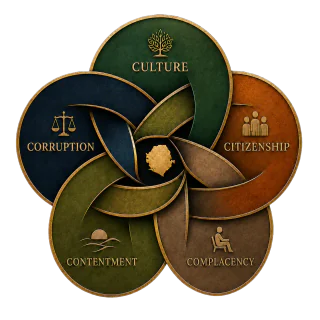
The Five C Theory Culture, Corruption, Citizenship, Contentment, and Complacency in Sierra Leone The book examines five interconnected forces that shape Sierra Leonean public life:
- Culture
- Corruption
- Citizenship
- Contentment
- Complacency
The Five C Theory does not present these forces as isolated national defects. It examines how they interact. Culture shapes belonging and obligation. Corruption can convert public authority into private access. Weak citizenship lowers public expectations. Contentment and resilience make institutional failure survivable. Complacency persuades citizens that meaningful action is unlikely to succeed. The purpose of this guide is not to lead every group toward the same conclusion. It is to help readers:
- examine the framework carefully
- connect ideas across the book
- test the theory against experience
- challenge assumptions
- distinguish evidence from interpretation
- discuss politically sensitive questions responsibly
- identify realistic points of civic and institutional intervention
The theory is not a sentence. It is a map.
Who Should Use This Guide
This guide is suitable for:
- university and secondary-school classrooms
- book clubs
- civic organizations
- professional associations
- public-service institutions
- religious communities
- political-education programs
- youth organizations
- diaspora associations
- libraries
- leadership programs
- community reading circles
- policy and governance workshops
The guide may be used after reading:
- the full book
- one part of the book
- a selected chapter
- the free book excerpt
- an article based on the Five C framework
Guidance for Facilitators
The subjects raised in this book are personal, political, cultural, institutional, and moral. Participants may hold strong views about:
- political parties
- public officials
- ethnic or regional identity
- religion
- corruption
- public institutions
- family responsibility
- national development
- diaspora influence
- civic protest
- government performance
A productive discussion requires more than allowing everyone to speak. It requires structure. The facilitator should help participants distinguish among:
- documented facts
- personal experience
- public allegations
- political opinion
- interpretation
- moral judgment
- speculation
Participants should not be pressured to disclose personal or confidential experiences. Where sensitive examples arise, discuss the pattern without naming private individuals. The facilitator should prevent the conversation from becoming:
- an unverified accusation session
- a party-political rally
- an ethnic or regional argument
- an attack on Sierra Leonean culture
- a competition over who has suffered most
- a debate in which the loudest participant dominates
The objective is not to remove disagreement. It is to make disagreement useful.
Recommended Ground Rules
Before beginning, ask participants to accept the following principles.
- Critique ideas and conduct without dehumanizing people Strong criticism is permitted. Personal humiliation, insults, and group-based contempt are not.
- Distinguish evidence from suspicion Participants may discuss concerns, but they should identify whether a claim is documented, alleged, inferred, or personally observed.
- Apply the same standard consistently Ask whether the judgment would change if another party, region, family, religion, or community were involved.
- Do not make one participant represent an entire group No participant should be required to defend a political party, ethnic group, region, religion, profession, generation, or social class.
- Protect confidentiality Do not repeat personal stories outside the group without permission.
- Allow people to revise their views Changing one’s mind should be treated as intellectual honesty, not defeat.
- Make space for quieter voices No participant should dominate the conversation.
- Focus on systems as well as individuals Personal responsibility matters, but institutions, incentives, rules, and power relationships also shape behavior.
- Distinguish explanation from excuse Understanding why conduct occurs does not automatically justify it.
- End with a question, finding, or action Discussion should produce greater clarity, not only stronger frustration.
Preparing the Discussion
Before the session, the facilitator should decide:
- which chapters or parts participants will read
- how much time is available
- whether the group will meet once or several times
- whether the discussion will be public or private
- whether participants will complete a written exercise
- whether the group will produce a practical recommendation
- whether political or institutional sensitivities require additional safeguards
Useful materials include:
- copies of the book
- the Five C Reflection Guide
- paper or notebooks
- a visible timer
- a whiteboard or flip chart
- the Five C cycle diagram
- printed discussion questions
- case-study worksheets
Opening the Conversation
Begin with one of the following questions.
Opening Prompt One
Which of the Five Cs first attracted your attention, and why?
Opening Prompt Two
Which chapter felt closest to your own experience?
Opening Prompt Three
Which argument did you initially resist?
Opening Prompt Four
Which sentence or idea stayed with you after reading?
Opening Prompt Five
What public issue would you like to understand through the Five C framework? The opening should invite participation without immediately forcing political disagreement.
Understanding the Framework
Use these questions before discussing the individual parts.
- What is the central argument of the Five C Theory?
- Why does the book connect the five forces rather than analyze them separately?
- Which connections among the Five Cs are most convincing?
- Which connections require more evidence or explanation?
- Does the framework describe every Sierra Leonean institution and community equally?
- Where might the theory be less applicable?
- What important factor may fall outside the Five Cs?
- Does the theory place enough emphasis on economic conditions, history, class, gender, or international influence?
- What is gained by treating the theory as a map rather than a verdict?
- Which C appears to be the strongest entry point for reform?
Part One: Culture
Central Question
How can the same cultural values that strengthen family and community life weaken public fairness when they enter institutions?
Discussion Prompts
- What does culture mean within the argument of the book?
- Which Sierra Leonean cultural values contribute positively to public life?
- How do family obligation, respect, loyalty, faith, and communal responsibility help people survive?
- When can family obligation conflict with public duty?
- Is helping a relative always favoritism? Where should the boundary be drawn?
- What is the difference between using personal resources to assist someone and using public authority to favor someone?
- Why might an official find it difficult to refuse requests from relatives or supporters?
- What social consequences may follow when someone refuses such requests?
- How can institutions protect public servants from improper social pressure?
- When does respect become silence?
- Can a person question an elder, leader, employer, religious figure, or official respectfully?
- What does respectful accountability sound like?
- Why do some communities treat criticism of one member as an attack on the entire group?
- When does loyalty become complicity?
- What is the difference between protecting a person’s dignity and protecting that person from accountability?
- Would you judge the same conduct differently if it involved another party, family, region, or ethnic community?
- How can families support relatives in public office without demanding unfair advantage?
- Which cultural values could be widened toward unknown citizens?
- What would a culture of truthful loyalty look like?
- Can culture change through law alone?
Culture Case Study
A newly appointed official receives requests from relatives for jobs, contracts, school placements, and help with administrative processes. Some relatives argue that the family sacrificed for the official’s education and now deserves support. Discuss:
- Which requests may be legitimate?
- Which requests cross into improper use of public authority?
- What pressures does the official face?
- What responsibility does the family carry?
- What rules should the institution provide?
- How can the official refuse without appearing to reject the family?
- What would loyalty to both family and public duty require?
Part Two: Corruption
Central Question
Why does corruption survive even when many citizens and officials recognize its harm?
Discussion Prompts
- How does the book define corruption beyond the brown envelope?
- Which forms of corruption receive less public attention because no money changes hands?
- How do favoritism and selective enforcement weaken public institutions?
- What is the difference between a personal favor and a corrupt advantage?
- How does patronage convert public resources into political loyalty?
- Why might citizens depend on connections even when they oppose corruption?
- Does using a connection make every citizen equally responsible?
- How should responsibility be assessed according to power, urgency, vulnerability, and available alternatives?
- Why do formal procedures lose credibility?
- What happens when knowing someone becomes more useful than understanding the rule?
- How does corruption affect citizens who refuse to participate?
- What does corruption steal besides money?
- How does it affect competence?
- How does it affect trust?
- How does it affect national belonging?
- Why do political parties often condemn patronage in opposition and practice it in government?
- What makes accountability fail after an investigation or audit becomes public?
- Why is exposure not the same as accountability?
- What stages should follow exposure?
- What protects ethical public servants and professionals?
- Can anti-corruption laws succeed where institutions remain politically dependent?
- What role do citizens play in rewarding or resisting corrupt behavior?
- How can an institution reduce dependence on personal access?
- Which public procedure should be made clearer or more transparent?
Corruption Case Study
A public vacancy is advertised, but many applicants believe the successful candidate was chosen before the process began. The selected candidate is qualified, but also closely connected to senior officials. Discuss:
- Does qualification alone make the appointment fair?
- What evidence would be required before alleging corruption?
- Which parts of the recruitment process should be public?
- How should conflicts of interest be handled?
- What harm occurs even when the selected person is competent?
- How does the process affect applicants who lack connections?
- What reforms would strengthen credibility?
Part Three: Citizenship
Central Question
What does citizenship require beyond nationality, voting, and political support?
Discussion Prompts
- What is the difference between a citizen, supporter, client, and subject?
- Can one person behave as all four at different times?
- What does it mean for citizenship to carry standing?
- Why are public services often experienced as favors rather than rights?
- What happens when citizens become indebted to officials for ordinary public services?
- Can strong party loyalty coexist with independent citizenship?
- What should a supporter do when the party violates the standards it once defended?
- Is criticism from within a party an act of betrayal or responsibility?
- What responsibilities do opposition citizens carry?
- What does citizenship require between elections?
- Why is public memory important?
- What happens when citizens forget promises, unfinished projects, and unresolved investigations?
- How can citizens preserve public records?
- Why is local participation important?
- Which local institutions affect daily life most directly?
- What is the unknown citizen test?
- Would a familiar institution work for someone with no influential connection?
- What information should institutions publish?
- What rights are commonly treated as personal favors?
- What duties do citizens owe public institutions?
- Can a citizen demand fairness while seeking unfair exceptions?
- How can citizens protect public property and public truth?
- What is the difference between respectful engagement and submission?
- What does it mean to return after a promise is made?
- How can citizenship become a repeated practice rather than an occasional identity?
Citizenship Case Study
A community receives a new public facility shortly before an election. Political leaders describe the project as a gift to loyal supporters. Discuss:
- Is the facility a political gift or a public obligation?
- How does the language of gratitude affect citizenship?
- Should citizens thank the official?
- Can gratitude and accountability coexist?
- What information should the community request?
- How should the project be discussed after the election?
- What would equal citizenship require if another community did not receive similar support?
Part Four: Contentment
Central Question
When does a personal virtue begin lowering public expectations?
Discussion Prompts
- How does the book define contentment?
- What moral and emotional strengths can contentment provide?
- How can contentment reduce greed or political purchase?
- What is the difference between personal contentment and civic contentment?
- Can a person live modestly while demanding strong public institutions?
- How does resilience help Sierra Leonean families and communities?
- What is the hidden cost of adaptation?
- What does it mean for resilience to become an institutional subsidy?
- Which public failures are currently being absorbed by private households?
- How do families compensate for weak education, health care, water, electricity, transport, or security?
- Who can afford private alternatives?
- Who is excluded because they cannot adapt?
- Why might public institutions underestimate failure when citizens continue managing?
- What does the phrase “we are managing” conceal?
- What is the relationship between patience and political power?
- When does patience become permission?
- What should patience require from institutions?
- How can faith strengthen civic responsibility?
- When can religious language discourage public action?
- What is the difference between trusting God and excusing human negligence?
- How can private adaptation become public evidence?
- What costs should communities document?
- How can resilience be redirected toward prevention and reform?
- Should citizens ever stop compensating for public failure?
- How can citizens survive immediate hardship without normalizing it?
Contentment Case Study
A community has unreliable water. Residents buy storage tanks, purchase water from vendors, and rely on private boreholes. Over time, public pressure for repair weakens because many households have created private solutions. Discuss:
- Who benefits from the private arrangements?
- Who remains vulnerable?
- What public failure has become less visible?
- How much are residents paying privately?
- What evidence should be collected?
- Should residents stop buying water to create pressure?
- How can they survive while still organizing publicly?
- What would responsible institutional patience require?
Part Five: Complacency
Central Question
How does repeated disappointment teach citizens to surrender expectation?
Discussion Prompts
- How does the book distinguish complacency from laziness?
- Can hardworking people be politically complacent?
- What experiences teach citizens that nothing will change?
- Why does lowered expectation protect people emotionally?
- How does private complaint function as relief?
- Why does private complaint rarely pressure institutions?
- Which failures have become normalized?
- How does language make failure sound ordinary?
- What happens when unfinished projects no longer produce surprise?
- How does institutional silence strengthen complacency?
- Why do citizens stop submitting complaints?
- What role does fear play?
- What role does exhaustion play?
- What role does political division play?
- What role does weak civic organization play?
- What is the difference between patience and surrender?
- What would sustained civic expectation look like?
- What small public result could rebuild confidence?
- Why are visible victories important?
- Can one successful campaign alter expectations beyond the original issue?
- How can citizens act without depending on heroic individuals?
- What protections make public action safer?
- How can civic groups avoid becoming partisan or personally controlled?
- How should citizens respond when an institution offers partial progress?
- When should a group change tactics rather than abandon the issue?
Complacency Case Study
Residents have complained privately for years about an unfinished road. Several letters were sent, but no clear response was received. Most people now believe further action is pointless. Discuss:
- Why did the earlier attempts fail?
- Was the responsible institution clearly identified?
- Was the demand specific?
- Was evidence preserved?
- Did citizens return after sending the letters?
- Was the issue collectively owned?
- What new strategy could be attempted?
- What small result would demonstrate progress?
- How can the group avoid promising more than it can achieve?
Breaking the Cycle
Central Question
Where can the Five C cycle be interrupted?
Discussion Prompts
- Which C is easiest to recognize?
- Which C is hardest to confront?
- Which C is most within the control of ordinary citizens?
- Which requires the strongest institutional action?
- Can reform begin in more than one place?
- How can culture become a resource for accountability?
- How can contentment restrain greed without reducing public expectations?
- How can citizenship weaken corruption?
- How can institutional response reduce complacency?
- What does routine accountability require?
- Why are records important?
- Why must explanations be public?
- What is the difference between punishment and institutional correction?
- How should officials who act ethically be protected?
- How can citizens move from broad frustration to a specific demand?
- What role do professionals play?
- What role do religious leaders play?
- What role does the media play?
- What role do political parties play?
- What role does the diaspora play?
- What reforms should survive a change of government?
- What public standard should never depend on which party is in power?
- How can citizens recognize progress without becoming satisfied with partial reform?
- What must Sierra Leone refuse to normalize?
Five C Case-Mapping Exercise
Choose one public issue. Examples:
- an unfinished road
- a failing school
- an understaffed clinic
- an unclear recruitment process
- unreliable electricity
- delayed public documents
- unequal law enforcement
- an unresolved audit finding
- a stalled community project
- public resources distributed through political networks
Step One: Define the Issue
What happened?
Which institution is responsible?
What public standard applies?
Step Two: Culture
Which loyalties, relationships, hierarchies, expectations, or values influence the issue?
Step Three: Corruption
Where might private access, favoritism, conflict of interest, or selective enforcement affect the issue?
Step Four: Citizenship
Are people responding mainly as citizens, supporters, clients, or subjects?
Step Five: Contentment
How are citizens or households carrying the cost privately?
Step Six: Complacency
Why might people believe that action will fail?
Step Seven: Responsibility
Who has the greatest authority to correct the problem?
Who carries the greatest cost?
Who has the least protection?
Step Eight: Public Question
What should the responsible institution answer?
Step Nine: Specific Demand
What action should occur?
By whom?
By what date?
Step Ten: Follow-Through
How will the group preserve the record and return?
From Complaint to Public Action Exercise
The Complaint
Write the issue as people usually express it. Example: “Nothing works.”
The Public Question
Convert the complaint into a question that identifies responsibility. Example: “Which institution is responsible for maintaining this road, what funds were allocated, and why did work stop?”
The Evidence
What records, dates, photographs, documents, testimonies, or official statements are available?
The Demand
Complete the sentence: “We are asking ____ to ___ by _____.”
The Coalition
Who should participate?
- affected residents
- professionals
- local leaders
- journalists
- religious institutions
- civic organizations
- elected representatives
- lawyers
- youth groups
- diaspora associations
Participants:
The Return Date
When will the group assess the response?
Short Discussion Formats
Thirty-Minute Reading Circle
5 minutes
Opening question: Which idea from the reading felt most relevant?
10 minutes
Discuss one core question.
10 minutes
Apply the idea to one public issue.
5 minutes
Complete: “One thing I understand differently is…”
Sixty-Minute Session
10 minutes
Welcome and ground rules.
10 minutes
Individual reflections on one C.
20 minutes
Focused group discussion.
15 minutes
Case-mapping exercise.
5 minutes
Closing commitments.
Ninety-Minute Session
10 minutes
Opening and ground rules.
15 minutes
Overview of the Five C cycle.
25 minutes
Small-group discussion.
25 minutes
Case study and public-question exercise.
10 minutes
Group recommendations.
5 minutes
Closing reflection.
Two-Hour Civic Workshop
15 minutes
Introduction to the framework.
25 minutes
Culture and corruption discussion.
20 minutes
Citizenship discussion.
20 minutes
Contentment and complacency discussion.
25 minutes
Case-mapping exercise.
10 minutes
From complaint to demand.
5 minutes
Closing action statements.
Multi-Session Reading Circle
Session One
Introduction and Part One: Culture
Session Two
Part Two: Corruption
Session Three
Part Three: Citizenship
Session Four
Part Four: Contentment
Session Five
Part Five: Complacency
Session Six
Breaking the Cycle At the final meeting, the group should produce:
- one shared insight
- one disagreement requiring further thought
- one public question
- one realistic civic or institutional recommendation
Classroom Discussion Activities
The Same Standard Test
Present two similar situations involving different political parties, regions, or groups. Ask:
- Does your judgment change?
- What principle should apply in both cases?
- What explains the inconsistency?
The Unknown Citizen Journey
Select a public process. Map what happens to a person without:
- a relative inside the institution
- political access
- professional influence
- financial resources
- a community leader’s intervention
Identify points where the process may become unfair.
The Public–Private Cost Ledger
Select one weak public service. List what citizens pay privately through:
- money
- time
- unpaid labor
- stress
- travel
- missed education
- lost employment
- health consequences
- inequality
Exposure or Accountability?
Provide a hypothetical corruption allegation. Ask which stages remain:
- allegation
- preliminary assessment
- investigation
- official response
- judgment
- consequence
- recovery
- correction
- public explanation
Loyalty or Complicity?
Present a case in which a participant’s ally is accused of misconduct. Ask:
- What would loyalty require?
- What would fairness require?
- What would complicity look like?
- What process should be followed?
Discussion Prompts for Faith Communities
- How can faith strengthen public courage?
- When does patience become permission for continued failure?
- What responsibilities do religious leaders carry when public wrongdoing affects their communities?
- How can religious institutions model transparency?
- Can prayer and public action strengthen one another?
- How should religious communities respond when loyalty to a leader conflicts with truth?
- What does stewardship mean in public life?
- How can contentment resist greed without lowering civic expectation?
- What moral obligations extend beyond family and congregation?
- What would faithful citizenship require?
Discussion Prompts for Diaspora Groups
- How does distance shape the way diaspora communities understand Sierra Leone?
- Does financial support reduce or increase pressure for institutional reform?
- When does emergency assistance become a permanent substitute for public systems?
- How can diaspora support build capacity rather than dependence?
- What responsibilities do diaspora citizens carry beyond criticism and remittances?
- How can diaspora organizations model transparency?
- What kinds of knowledge or influence can be shared responsibly?
- How can diaspora voices avoid dominating people living with the daily consequences of policy?
- What forms of civic partnership are most sustainable?
- How can diaspora communities support the unknown citizen rather than only relatives and familiar networks?
Discussion Prompts for Public Servants and Professionals
- What pressures make it difficult to apply rules consistently?
- How do family, political, and professional relationships affect decision-making?
- What protections do ethical employees need?
- Which procedures depend too heavily on personal discretion?
- What information should be public?
- How can conflicts of interest be disclosed and managed?
- What happens to professionals who refuse improper instructions?
- How can institutions reward integrity rather than only loyalty?
- What does public service owe the unknown citizen?
- How can accountability become routine rather than exceptional?
Discussion Prompts for Political Groups
- Can a party encourage loyalty without demanding moral surrender?
- How should supporters criticize their own leaders?
- Why do parties often change standards when they gain power?
- What internal accountability systems should parties maintain?
- How should parties distinguish political appointments from professional public service?
- What public standards should apply regardless of who governs?
- How does patronage weaken long-term party development?
- What responsibilities do opposition parties carry beyond criticism?
- How can manifestos become tools of public accountability?
- What does democratic citizenship require between election campaigns?
Closing Reflection
At the end of the session, ask each participant to complete one or more statements. One idea I understand differently is:
One assumption I need to question is:
One public standard I want to apply consistently is:
One institution I want to understand better is:
One conversation I need to continue is:
One action I can take is:
Group Closing Statement
Invite the group to complete the following sentence: “We should no longer accept ________ as normal.” Then ask: “What is the first public question we should preserve?”
Continue the Conversation
The Five C Theory moves from cultural analysis and institutional diagnosis toward citizenship, accountability, public action, and national renewal. The purpose of the framework is not to deepen despair. It is to identify where familiar patterns can be interrupted. Read carefully. Question consistently. Apply the same standard across political and social boundaries. Preserve public memory. Turn private frustration into precise public questions. Return after promises are made. A country begins to change when it can hear itself publicly.
The Five C Theory Culture, Corruption, Citizenship, Contentment, and Complacency in Sierra Leone Bhai-Dhawa Sesay